.png)
Restaurant AV Control: Why Placement Matters During Service
In restaurants and hospitality environments, control often gets treated as a feature of the system. There is an app, a touchscreen, a wall-mounted interface, or a tablet that gives someone access to music, TVs, lighting, and other systems. From a technology standpoint, the requirement appears to be satisfied: the operator has control.
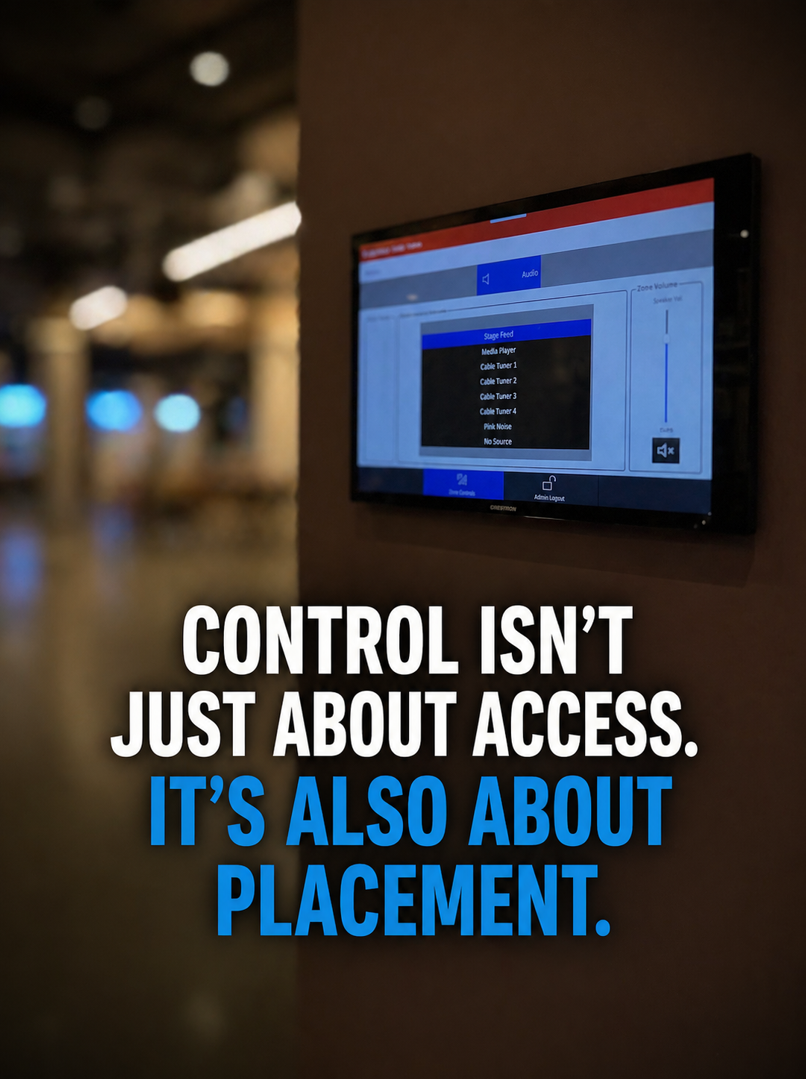
But having control and being able to use it effectively during service are two different things. Where that control is physically located can matter just as much as what the system is capable of doing.
A control interface might end up behind the bar, in the manager’s office, back in the kitchen, at the host stand, or on a floating tablet. Too often, that location is determined by where there is available wall space, power, or a convenient pathway during construction rather than by understanding who will actually use the system and where that person will be when they need it.
Restaurant AV Control Should Follow the Operation
During service, managers and shift leads are moving through the venue. They are watching the floor, responding to guests, supporting employees, managing the environment, and making adjustments as conditions change.
If the music needs to come down, a television needs to change, or the lighting needs to move to the next scene, the person making that adjustment shouldn’t have to disappear into an office or walk to another part of the building simply because that is where the control interface was installed.
The problem becomes even more apparent when the operator can’t see or hear the result from the control location. They make the change, return to the floor to check it, discover that it isn’t right, and then go back to the controls again.
Nothing is necessarily wrong with the technology. The system may be operating exactly as designed. The problem is that the design didn’t account for the operation.
Fork & Tech approaches technology decisions from the operating environment backward. Restaurant Technology from the Operator's Side of the Counter explores why technology decisions should begin with how people actually work rather than simply what a system can do.
Control Is About Visibility as Much as Access
Good control placement should give the operator more than access. It should provide enough proximity and visibility to understand whether the action they took produced the intended result.
That becomes particularly important with AV and lighting. Changing a television source without being able to see the display, adjusting music without being able to hear the affected zone, or selecting a lighting scene without seeing the space creates unnecessary operational friction.
In a sports bar or entertainment-driven environment, that friction can become even more significant. Multiple displays, audio zones, lighting scenes, private areas, events, and changing programming can require frequent adjustments throughout the day. Streamline Your Hospitality AV Control System: How to Ditch the Remote Control Chaos looks specifically at simplifying AV control by bringing TVs, audio, sources, volume, and other functions into a more manageable control environment.
The goal isn’t to put every control everywhere. It is to understand who needs control, what they need to control, where they will be when they need it, and what feedback they need to confirm that the change actually happened.
A Small Design Decision Can Create Daily Friction
Control placement can look like a minor detail on a technology drawing. Operationally, it can become a decision employees interact with hundreds or thousands of times over the life of the venue.
A few extra steps to reach a control panel may not seem important during design. During a busy service, those steps compete with everything else the manager or employee is responsible for doing. The same principle applies throughout hospitality technology: equipment locations, POS placement, printer locations, wireless coverage, display positioning, rack locations, and control points all influence how people interact with the environment.
That is why Fork & Tech looks beyond whether individual systems technically work. What We Do explains how technology and AV infrastructure are designed and coordinated around the operation, from early decisions through implementation and operational readiness.
Design the Control Point Before the Wall Is Finished
The best time to determine control placement isn’t after the AV system has been commissioned. It is during planning and design, while workflows, equipment locations, pathways, power, network requirements, and system interfaces can still be coordinated.
That requires asking operational questions early. Who changes the music during service? Who manages television content? Does the bartender need access? Does the manager need broader control? Are there different permissions for different roles? Can the person making the change see or hear the affected area? Does control need to exist in more than one location?
Those questions may influence the location and number of interfaces, the control architecture, network connectivity, device selection, programming, permissions, and even how the system is documented.
Fork & Tech uses Seam™ to carry decisions like these from planning and design through coordination, implementation, validation, documentation, and operational readiness. The objective is to make sure a decision that affects the operation remains visible and owned throughout the project instead of becoming an installation decision at the end.
Installation Is Where the Design Becomes Real
Even when the control strategy is correct on paper, execution matters. A device installed in a slightly different location because it was easier for the installer can change how useful that control point is to the operator.
The same applies to labeling, cabling, equipment placement, and documentation. Restaurant Cable Management and Labeling: Why the Details Matter explains why installation details that may appear small during construction can have long-term consequences for operations, troubleshooting, maintenance, and future changes.
Control placement deserves the same attention. The question at the end of the project shouldn’t only be, “Does the control work?” It should also be, “Can the operator use it effectively from where we put it?”
The System Has to Work for the People Using It
Once the venue opens, employees will find the fastest way to accomplish what they need to accomplish. If the intended control workflow is inconvenient, they will create another one.
A tablet gets moved. Someone keeps a remote behind the bar. Employees start calling the manager for simple changes. A control panel gets ignored. Eventually, the workaround becomes the operating procedure.
That is valuable feedback about the design. Technology should reduce friction in the operation, not require the operation to compensate for where the technology was placed.
For environments that continue changing after opening, ONE provides an ongoing technology management framework for support, vendors, documentation, projects, systems, standards, and planning so operational issues and future changes can be managed as part of the larger technology environment.
Control isn’t just about access. It’s also about placement.
The right interface in the wrong location can still be the wrong solution.
Where do your managers or shift leads actually control music, TVs, or lighting during service?
Planning a new restaurant or hospitality venue, remodeling an existing location, or evaluating an AV and control environment that isn’t working the way the operation needs it to? Contact Fork & Tech to start the conversation.


Comments