
When Did Restaurant Discounts Become a Job for the Guest?
Promotions are supposed to make it easier for a guest to say yes.
But what happens when receiving the discount requires scanning a coupon that doesn't work, creating an account, rebuilding an order, entering information the guest wasn't expecting to provide, or finding an employee to fix the transaction?
At some point, restaurant discounts can create more friction than value when the redemption process becomes harder than the offer should be.
I've experienced this from both sides of the counter—as a customer trying to redeem an offer and as an operator responsible for making sure a promotion could actually be executed in a restaurant.
Those experiences point to a larger issue: restaurant promotion technology cannot be evaluated only by whether the offer exists in the system. It also has to work for the guest and the operation.
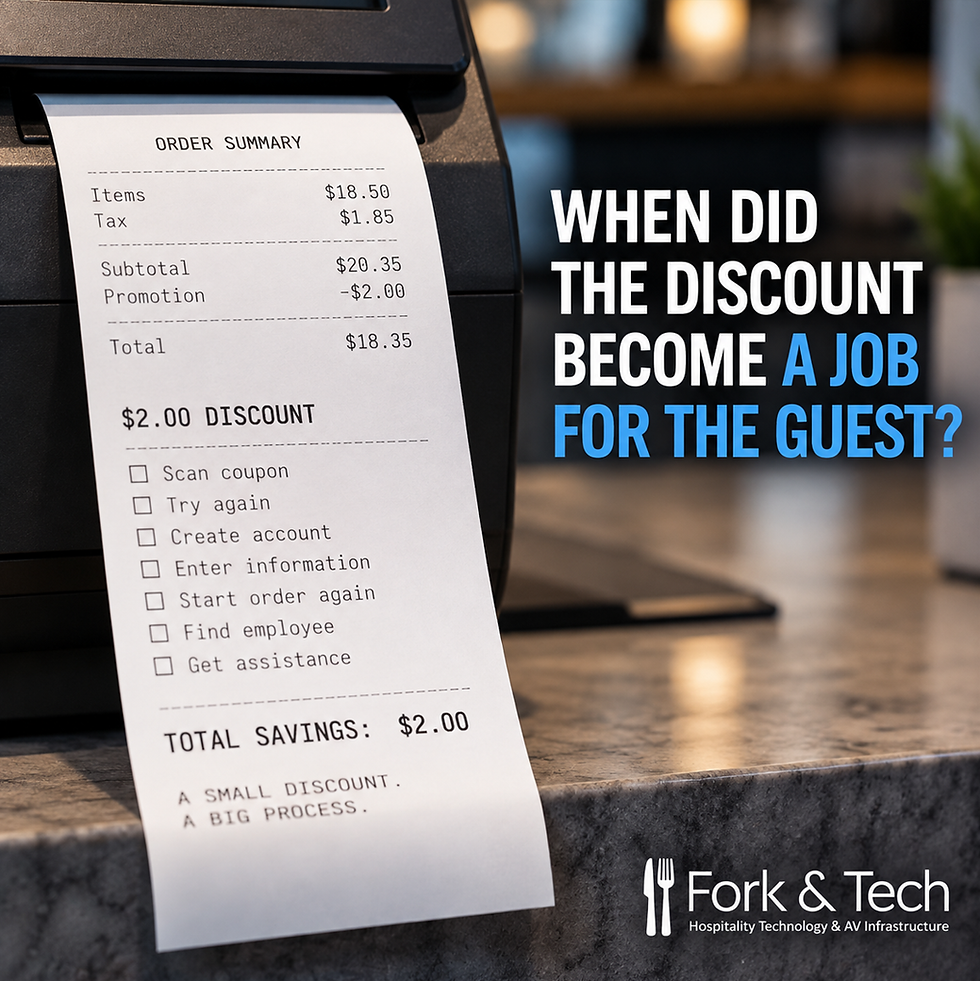
When Restaurant Discounts Become a Redemption Problem
In one experience, an in-store promotion offered $2 off a product. The promotion influenced the purchase decision, so in that sense it had already done its job.
At self-checkout, I scanned the coupon.
Invalid.
I tried again with the same result. Eventually, I had to find an employee who could override the transaction.
I received the discount, but the experience raised a more important question: How many guests would simply decide that $2 wasn't worth the effort?
In another experience, I placed a restaurant order online and entered an advertised promotional code. The ordering system required an account before the offer could be redeemed.
I created the account, but by the time I returned to the ordering process, my original pickup time was no longer available and I had to start the order again.
Again, the promotion worked as an incentive. The friction appeared during redemption.
That's an important distinction.
A Promotion Becomes an Operational Workflow
I've also experienced this problem from the operator's side.
Years ago, a promotion was scheduled to launch on a Monday. By the Friday before launch, the operators still didn't have clear direction on how it worked, how guests would redeem it, how exceptions should be handled, or how the results would be reported.
I created a guide because I couldn't imagine asking restaurant teams to execute something they hadn't been prepared to support.
That experience stayed with me because it demonstrated something that is still relevant: a promotion may begin with Marketing, but the guest experiences it through the operation.
Front-of-house employees have to understand it. The POS or ordering technology has to recognize it. Managers need a way to handle exceptions. Loyalty and customer systems may need to identify eligibility. Reporting needs to capture the transaction correctly. Even the kitchen can be affected if a promotion changes product mix or order volume.
The guest doesn't care which department owns each piece.
They experience one restaurant.
Restaurant Promotion Technology Has to Work Across Systems
Restaurant promotions increasingly cross several technology systems.
An offer might originate in a marketing or loyalty platform, appear in an email or mobile application, be redeemed through online ordering, and ultimately need to be recognized correctly by the POS.
That creates dependencies between systems that may be owned by different vendors or different teams.
The offer itself may be configured correctly while the complete guest journey still fails.
For example, what happens when:
a promotional code is recognized online but not at the POS?
a loyalty account is required but account creation interrupts the ordering process?
a coupon works in one ordering channel but not another?
an employee doesn't know how to handle an exception?
the POS requires a manager override for an advertised offer?
a guest qualifies for a promotion but the systems responsible for recognizing eligibility don't agree?
Each system can technically be "working" while the overall experience is not.
This is one reason Fork & Tech approaches restaurant technology from the operation outward. The individual systems matter, but so do the connections, workflows, dependencies, and people between them. Our broader approach to those environments is outlined in What We Do.
The Metrics Don't Always Show Who Gave Up
Restaurant technology provides an enormous amount of measurable information.
Operators can evaluate redemption, enrollment, conversion, spend, frequency, average check, ordering behavior, and other performance indicators.
What can be harder to see is the guest who tried to redeem an offer and gave up.
That guest may never appear as a failed transaction.
They may abandon the order after being asked to create an account. They may decide the discount isn't worth waiting for an employee. They may remove the promotional item from their basket. Or they may simply decide that ordering somewhere else is easier.
From the business side, everything may still appear to be functioning.
The promotion is active.
The loyalty platform is enrolling customers.
The ordering system is accepting orders.
The POS is processing transactions.
But system availability and guest usability are not the same measurement.
Test the Journey, Not Just the Configuration
A promotion should be tested the way a guest will actually experience it.
That means going beyond confirming that a discount code exists or that a promotion has been configured correctly in the system.
Walk through the complete transaction.
What does the guest see?
What information are they required to provide?
Does the offer work across the intended ordering channels?
What happens when something goes wrong?
Can an employee resolve the problem?
Does the guest have to restart any part of the transaction?
Does the final receipt accurately reflect what happened?
And importantly, how much effort did the guest have to contribute to receive the benefit the business was trying to give them?
This is the same operational-readiness principle that applies elsewhere in restaurant technology. Technology should be validated against the real operating environment rather than simply checked off as installed or configured.
For technology projects, Fork & Tech uses Seam™ to bring structure to requirements, decisions, vendors, implementation, validation, and operational readiness. A promotion or loyalty workflow may look very different from an AV or network installation, but the underlying question is similar: does the finished technology actually work the way the operation needs it to work?
Friction Can Work Against the Purpose of the Promotion
There is real value in promotions, loyalty programs, and understanding guest behavior.
The issue isn't whether restaurants should use them. The issue is how much friction we're willing to introduce while doing it.
Every additional step has a purpose from somewhere inside the business. Account creation may help identify the guest. Authentication may protect an offer from misuse. Data collection may support personalization. Redemption rules may protect margins.
Those can all be legitimate requirements.
But they also have a cumulative effect on the guest experience.
The technology decision therefore isn't simply whether a feature is possible. Operators should understand what the business gains from each requirement and what the guest is being asked to do in return.
That is an operational decision as much as a technology decision.
Design From the Guest and Operator Backward
Restaurant technology is often evaluated from the system outward:
What features does the platform have?
What integrations are available?
What information can we collect?
What rules can we configure?
A different approach is to start with the people using it.
What is the guest trying to accomplish?
What does the employee need to know?
What happens when the expected workflow fails?
What does the manager need to resolve an exception?
What information does the business actually need?
Then work backward into the technology.
That's consistent with a larger principle we use at Fork & Tech: technology should enable people.
The objective isn't to remove every step from every process. It is to make sure the steps we introduce create enough value to justify the friction they add.
The Promotion Isn't Finished Until the Guest Receives It
A promotion can be configured correctly, advertised successfully, and measured accurately while still creating a poor experience at redemption.
That's why success shouldn't be measured only by whether the promotion launched or whether the technology processed it.
The complete experience matters.
Did the guest understand the offer?
Could they redeem it without unnecessary effort?
Could employees support it?
Could managers resolve exceptions?
Did the technology behave consistently across the systems involved?
And did the process reinforce the relationship the promotion was intended to create?
Maybe the better question isn't simply whether the promotion worked.
How much work did we make the guest do to receive it?
At some point, the discount stops feeling like a reward and starts feeling like compensation for getting through the process.
If you're evaluating POS, online ordering, loyalty, guest-facing technology, or the operational workflows connecting those systems, Contact Fork & Tech to talk through the environment and where we may be able to help.


Comments