
Technology Should Enable People: Designing Restaurant Technology Around the Guest Experience
Every technology decision helps shape the operation.
Here’s the question I think we should ask more often: How will this technology help our people create a better guest experience?
We spend a lot of time comparing features, platforms, integrations, specifications, and capabilities. Those things matter, but they don’t tell the whole story. Once technology enters a working restaurant or hospitality environment, it becomes part of how people do their jobs.
That means a technology decision is rarely just a technology decision. It can affect workflow, movement, communication, speed of service, decision-making, and ultimately the experience a guest has.
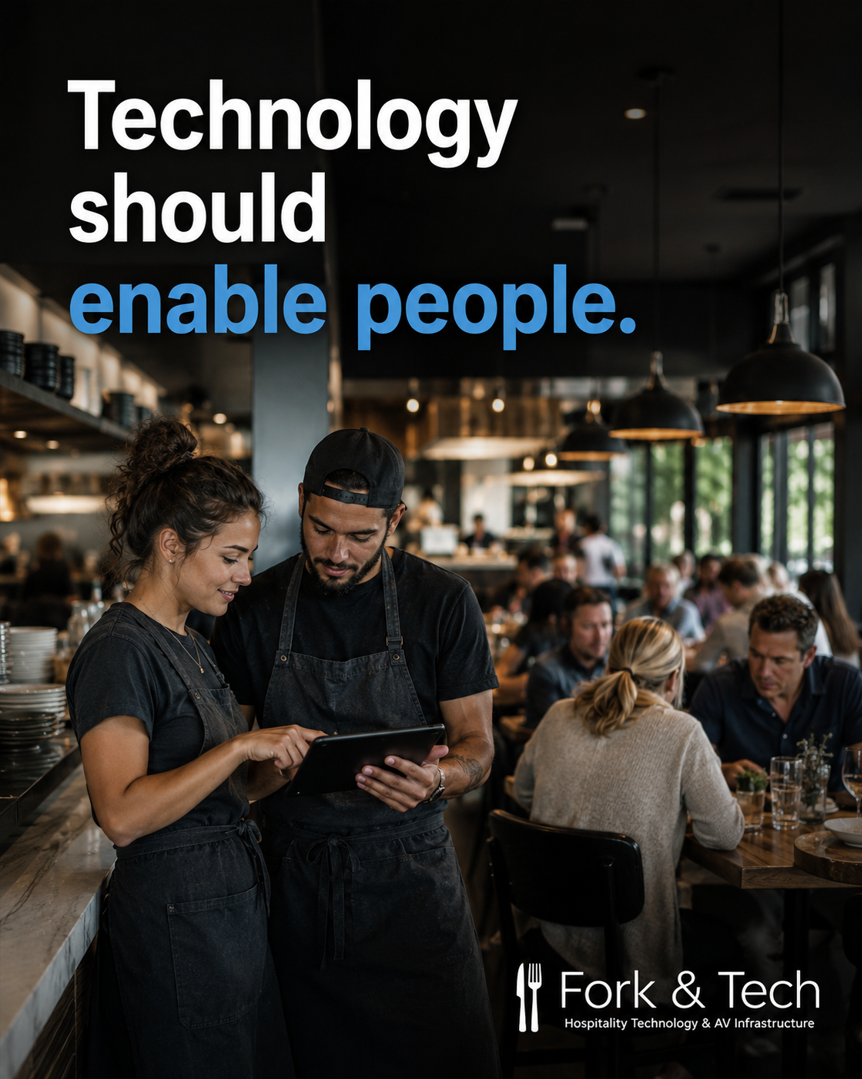
Restaurant Technology Decisions Are People Decisions
Consider something as simple as where a kitchen printer is installed.
From a technology perspective, the printer needs power, network connectivity, the correct configuration, and a place to sit. From the operator’s perspective, its location can determine how far someone walks hundreds of times during service.
A few extra steps may not seem significant during design. Repeated across every order, every shift, and every day, those steps become part of the operation.
The same thing happens with POS.
Changing a POS workflow doesn’t simply add or remove a screen. Button placement, modifiers, prompts, permissions, payment steps, and exception handling influence the rhythm of every transaction. A workflow that adds only a few seconds can become significant when multiplied across hundreds or thousands of transactions.
This is why we approach technology from the operation outward. As we discuss in Restaurant Technology From the Operator’s Side of the Counter, the question isn’t simply whether the system technically works. It’s whether it works for the operation.
How Restaurant Technology Shapes the Guest Experience
Some restaurant technology is directly visible to the guest. Online ordering, loyalty, digital menus, payment technology, kiosks, and other guest-facing systems obviously affect the experience. But the connection between restaurant technology and guest experience extends well beyond the systems guests directly touch.
But the technology guests never see or directly interact with can influence their experience just as much.
A network problem can slow payments or interrupt ordering. Poor kitchen technology workflows can contribute to longer ticket times. An AV system can influence the energy of a sports bar or entertainment venue. Camera placement can affect how effectively managers understand an incident. A poorly located piece of equipment can create unnecessary work for employees throughout every shift.
Displays are another good example. They don’t simply show content. Their placement influences where guests sit, where they look, what they notice, and how they experience the space.
For sports-focused venues, those decisions become particularly important. Restaurant and Sports Bar AV: Preparing for Major Sporting Events looks at how sightlines, audio, content distribution, control, and infrastructure come together to support the actual venue experience.
Technology may operate behind the scenes, but its consequences often reach the guest.
Small Technology Decisions Can Become Large Operational Consequences
Technology projects naturally contain hundreds of decisions.
Where should this device be installed? How should this workflow operate? Which systems need to communicate? Where should network drops be located? How should an employee access a particular function? What happens when the normal workflow fails?
Individually, many of these decisions can appear small.
Operationally, they accumulate.
A printer location affects movement. A POS workflow affects transaction speed. A network design affects system availability. Display placement affects sightlines. Audio zoning affects how different areas of a venue feel. Documentation affects how quickly a future problem can be resolved.
That is why infrastructure and documentation matter beyond installation. In Build for the Next Person: Restaurant Technology Infrastructure That Lasts, we look at how labeling, organization, documentation, capacity, and supportability influence what happens long after opening day.
The technology may be installed once. The operation lives with the decision every day.
AI Should Be Evaluated the Same Way
AI is simply the newest example of this principle.
There is understandable interest in what AI can do for restaurants and hospitality businesses. The capabilities are evolving quickly, and there are real opportunities in forecasting, operations, guest engagement, labor, analytics, support, and decision-making.
But the first question shouldn’t be whether the technology is impressive.
The better question is whether it helps people make better decisions while there is still time to influence the outcome.
If AI helps a manager recognize a service issue before it becomes a guest complaint, that can create operational value. If it identifies a developing bottleneck before ticket times begin to climb, the team has an opportunity to respond. If it turns information that already exists across restaurant systems into something an operator can act on during service, it is enabling the person rather than simply producing more data.
Our article AI in Restaurants: Practical Uses, Benefits, and Considerations looks more broadly at where AI can fit into restaurant operations and the considerations that come with implementing it.
The useful question is moving from “Can AI do this?” toward “How does this help the operator?”
Technology Should Reduce Friction, Not Move It Somewhere Else
A new technology feature can solve one problem while quietly creating another.
An additional authentication step may improve security while slowing an employee workflow. A promotion may increase engagement while making redemption harder. A new platform may provide better functionality while requiring managers to maintain another login, portal, or process.
That doesn’t automatically make the technology decision wrong. It means the operational consequence needs to be understood.
We explored one version of this in When Did Restaurant Discounts Become a Job for the Guest?. A promotion can technically work while the redemption process creates enough friction that the guest experience suffers.
The same thinking should apply across restaurant technology. A feature shouldn’t be evaluated only by whether it can be implemented. We should also understand what work it adds, removes, or changes for the people involved.
Start With the Operation and Work Backward
The traditional technology conversation often begins with capability:
What can the system do? What features are available? What integrations does it support? What equipment is required?
Those questions still need answers.
But there is another set of questions that should come first.
What is the operation trying to accomplish? What does the guest need? What does the employee need? What happens during the busiest part of service? What happens when the expected workflow fails? What does the manager need in order to respond?
Then work backward into the technology.
That is part of the broader approach behind Fork & Tech’s What We Do. Technology, AV, infrastructure, vendors, and implementation should ultimately align around what the operation needs rather than forcing the operation to adapt unnecessarily around the technology.
For new restaurants, remodels, and larger technology projects, Seam™ applies that thinking across requirements, decisions, infrastructure, vendors, implementation, validation, documentation, and operational readiness.
Technology Should Enable People
Technology should simplify the operation so people can focus on what matters: serving guests and running the business.
That doesn’t mean technology should disappear or that every process should have fewer steps. It means the technology should have a clear operational purpose, and the value it creates should justify the complexity it introduces.
The best technology decisions aren’t measured by features alone. They’re measured by the people they enable and the guest experiences they help create.
So before evaluating the next POS platform, AI capability, AV system, digital signage solution, network design, or other piece of restaurant technology, I think the first question should be:
How will this technology help our people create a better guest experience?
Because the real value of technology isn’t measured only by what it does.
It’s measured by what it enables people to do.
If you’re planning restaurant or hospitality technology and want to evaluate the environment from the operation outward, Contact Fork & Tech to talk through what you’re trying to accomplish and where we may be able to help.


Comments